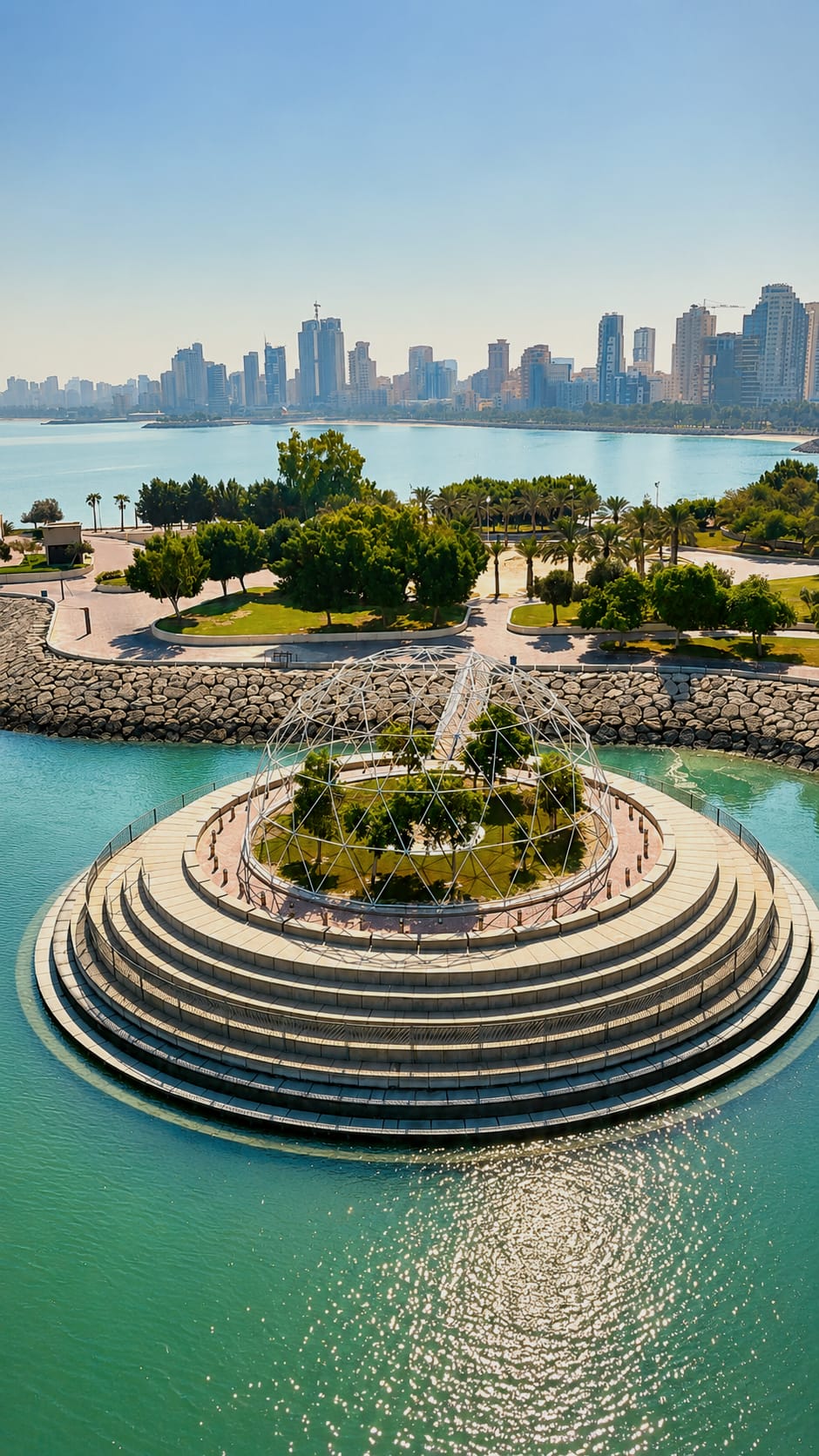
One of my fond memories of Green Island when I was little is riding the quadricycles (the family ones with 4 seats and a canopy for shade) along the winding paths, pedalling as fast as I could while the sea stretched out beside me. Some paths were uneven, while others dipped just enough to send us pedalling faster, laughing as we picked up speed. We’d race down the small slopes, only to brake suddenly at the very edge.
There’s something wonderfully retro about Green Island, a reminder of a different era of Kuwait when simple pleasures like a bicycle ride, an evening walk, getting delightfully lost, were enough to make a place unforgettable.
News that it may be demolished or redeveloped has prompted understandable discussion about tourism, investment, and the future of Kuwait’s waterfront. Cities evolve, and public spaces inevitably change with them which is understandable. The more difficult question is whether development can acknowledge what already exists, not only in concrete and infrastructure, but in collective memory.

There is a tendency to think of heritage as something ancient. We preserve old houses, archaeological sites, and historical monuments because they are recognised as part of our national story. Yet modern public spaces often escape that same consideration. They are seen as functional rather than meaningful, easily replaced by newer and more efficient versions of themselves.
Something increasingly uncommon in Kuwait, is a place that offers open lawns, accessible sea views, shaded walkways, and enough room for families to make the place their own. In a region where summer often pushes life indoors, Green Island became one of Kuwait’s earliest attempts to create a public landscape dedicated simply to leisure. Families, joggers, photographers, elderly couples, children, and visitors coexist within the same environment, each constructing their own relationship with it. These spaces become democratic not because they erase difference, but because they accommodate it.

The irony is that Green Island itself was once a symbol of modernity, and the Gulf region’s first manmade island. Created in 1988, project development began in 1978 which is an entire decade of construction. It was an ambitious waterfront project and reflected Kuwait’s confidence and optimism. Decades later, it has become old enough to require defending from the very cycle of progress it once represented! Looking back, this place was emblematic of a period when public spaces were designed with personality.
What has made Green Island even more meaningful to me is returning there as a parent. My daughter and I would pedal around the island together. On one visit, we stopped to watch a stork standing quietly in the water, turning an ordinary afternoon into a small lesson in noticing nature. We’ve climbed the observation towers, looked out across the sea, and spent joyful evenings at the festivals and community events hosted there. Watching my children experience the island reminds me that Green Island is not simply a place of nostalgia. It continues to create new memories for a new generation. That continuity is perhaps its greatest value. The measure of a public space is not only what it once meant to us, but whether it still has the ability to inspire wonder decades later.

What We Lose When We Replace Places
Although Green Island sat just off Kuwait City, crossing onto the island creates a subtle sense of escape. The traffic fades, the skyline becomes a distant backdrop, and the sea surrounds you on all sides. For a little while, the city feels far away. It’s a park that unfolds gradually through towers, bridges, hills, gardens, and winding paths. Every feature encourages exploration.
That quality is increasingly rare in contemporary public spaces. Many modern parks prioritize openness and efficiency, whereas Green Island invited people to slow down, wander without a destination, and discover something new with each visit. In that sense, its greatest achievement wasn’t any single structure, it was creating a landscape that felt endlessly explorable.
Aside from it’s landscaping, there is an artificial lake fed by seawater, an amphitheatre, playgrounds, bicycle rentals, a train ride, and a swimming pool. I also recall there being a zip-line ride across the artificial lake!

The Best Version of Itself
While redevelopment plans are being studied (wasn’t there a plan years and years ago stating that Green Island will turn into a “little city” complete with a resort?!), many people online have expressed hope that its character won’t be lost. At the same time, it’s difficult to ignore that the island has suffered from years of underinvestment. Closed facilities, aging infrastructure, and a lack of active attractions have left large parts of it underused.
On a side note, I have to admit, there is something strangely beautiful about Green Island’s faded but evergreen corners. The weathered structures, shuttered cafés, and forgotten facilities weren’t simply signs of neglect, they were reminders that the island had lived many lives. Walking through them felt less like visiting a park and more like wandering through a memory. There was a bittersweet charm to it, an atmosphere that invited curiosity. Empty kiosks, peeling paint, and aging observation towers gave Green Island an almost urban-exploration quality, as though each path led to a forgotten chapter of Kuwait’s past. It wasn’t beautiful because it was neglected; it was beautiful because it carried the marks of time.

Returning back to the main subject, the one addition that could genuinely transform Green Island is a thoughtfully curated collection of cafés and restaurants. Waterfront cafés, family restaurants, tea houses, and small local concepts that encourage people to linger for hours. Imagine sitting with a coffee overlooking the sea after a morning walk, having lunch after cycling with your children, or ending the evening with dessert while watching the sunset.
The island already has what many places spend millions trying to create: uninterrupted sea views, unique architecture, observation towers, winding pathways, picnic lawns, and a sense of discovery. What it’s missing is life between those spaces. Green Island doesn’t need to be replaced, it just needs to be restored, maintained, and activated.
Sometimes the most successful redevelopment isn’t about building something new, it’s about giving people more reasons to fall in love with what was already there.

I think Green Island doesn’t need to become an entirely different place, it needs to become the best version of what it already is. Just leave it be!
